Business Partnership Contracts Templates You Can Adapt to Use
Find out more about the availability of quality business partnership contracts template examples you can modify for your specific needs.
Business partnerships are often founded on confidence: confidence in an idea, in the prospects of the enterprise, and, perhaps most importantly, in the people or organisations involved. Yet confidence alone provides an uncertain basis for a continuing business relationship.
As expectations become obligations and individual interests intersect, the need for structure and clarity becomes increasingly apparent. A partnership contract template can provide a starting point for establishing that structure and clarity.
What Is a Business Partnership Contract?
A business partnership contract is a document that dictates how two or more people or entities will work together in a business relationship. The primary purpose of this contract is to set transparent terms and conditions for a cooperative, harmonious business arrangement among the parties, according to applicable partnership law.
What Should a Business Partnership Contract Template Include?
The contents of a business partnership contract template tend to vary according to the nature and needs of the partnership, but may include all, most, many or some of the following areas:
Parties and business details: Identify the partners and provide the basic information needed to establish who is entering the agreement.
Business name and purpose: State the name of the partnership and explain the business activities or purpose for which the partnership is being established.
Legal status and governing law: Establish the legal framework under which the partnership operates and identify the jurisdiction whose laws will govern the agreement.
Capital contributions: Specify what each partner will contribute to the business, whether in cash, property, assets, or another agreed form.
Ownership percentages: Clearly state each partner's ownership interest where the partners do not hold equal interests.
Profit and loss sharing: Explain how profits and losses will be allocated among the partners.
Management responsibilities: Define each partner's management role and the areas of the business for which they are responsible.
Decision-making: Establish how business decisions will be made, including any matters that require agreement or approval from the partners.
Financial management: Set out arrangements for managing partnership finances and other important financial matters.
Partner compensation: Where applicable, explain whether partners will receive compensation, drawings, or other payments from the partnership.
Intellectual property: Establish who owns intellectual property created, contributed, or used in connection with the partnership.
Confidentiality: Protect sensitive business information by defining the partners' obligations concerning confidential information.
Non-compete and non-solicitation provisions: Where legally permitted and appropriate, establish restrictions intended to protect the partnership's legitimate business interests.
Partner admission and withdrawal: Explain how new partners may be admitted and what happens when an existing partner chooses to leave.
Liability: Clarify relevant responsibilities and liabilities arising from the partnership's activities.
Dispute resolution: Establish a process for addressing disagreements between partners before they escalate.
Amendments: State how the agreement can be changed when the partners later agree to different terms.
Retirement and exit arrangements: Where relevant, establish how retirement or another form of partner exit will be handled.
Death or incapacity: Provide procedures for dealing with situations in which a partner dies or becomes unable to participate in the business.
Dissolution: Explain when and how the partnership may be dissolved and how its affairs will be handled afterwards.
Can You Adapt a Partnership Contract Template?
Yes. In fact, adaptation is one of the main advantages of starting with a template. Rather than treating a document as a finished agreement that applies to every business, partners can use it as a framework and replace the generic information with terms that reflect their actual arrangement.
A partnership contract template can be particularly useful when the partners already understand their proposed business structure but need help organising the terms into a formal document.
A partnership agreement template should nevertheless be reviewed carefully before it is used. Remove provisions that do not apply, add important terms specific to the partnership, and check that the template is appropriate for the jurisdiction involved.
Examples of Partnership Contracts Templates You Can Adapt to Use
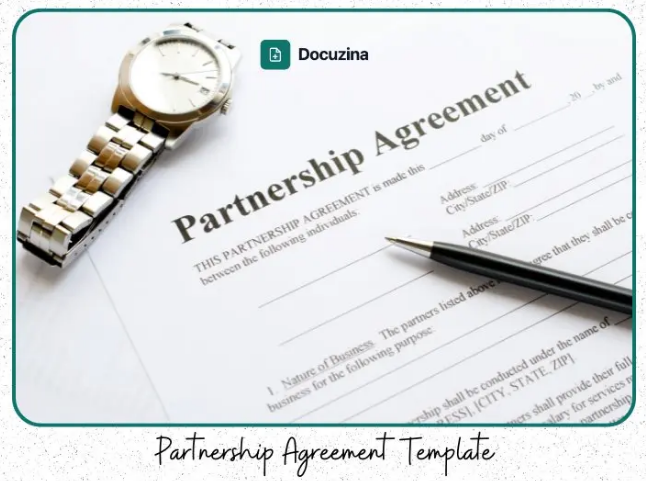
2. Partnership Agreement Template for Three Parties
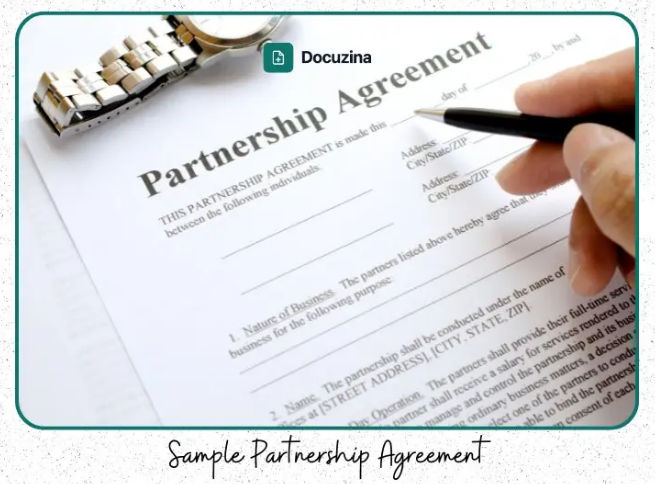
3. Business Partnership Agreement Template for Two or More Individuals
4. Partnership Contract Template for Two Parties
5. Partnership Agreement Template for Two Persons/Partners
Final Thoughts
For individuals considering a business partnership, the existence of adaptable templates raises an important practical question: must the agreement always be drafted from scratch? In most circumstances, the answer is no.
A suitable partnership agreement template can provide the underlying structure, while careful customisation can make its provisions relevant to the partners, their business model, and the arrangements they intend to establish.